AI Agents for DSCR and LTV Analysis Explained
Debt service coverage ratio and loan-to-value calculations are only as good as the assumptions behind them. AI agents can pull together borrower, property, and market data, run DSCR and LTV the same way every time, and catch mismatches before an analyst treats the numbers as reliable.

Debt service coverage ratio and loan-to-value usually turn on a handful of inputs, and those inputs change more often than the formulas do. In private commercial real estate lending, the hard part is rarely the math. It is deciding which NOI to use, which debt service figure belongs in the file, which valuation date still holds up, and which market assumption the lender will accept. This article explains how ai agents for dscr and ltv analysis can calculate those metrics from borrower, property, and market inputs while keeping a clear audit trail back to source documents and policy rules.
That matters because most DSCR and LTV exceptions come from inconsistent assumptions, not strange credit risk. A well-built agent can speed up the first pass, catch conflicts across rent rolls, trailing financials, appraisals, and sponsor submissions, and send the real judgment calls to an analyst instead of burying them in spreadsheet cleanup. For broader context, see ai agents for private commercial real estate lending and the related page on ai agents for cre underwriting.
Key Takeaways
- DSCR and LTV usually break because the numerator, denominator, or valuation basis is inconsistent across documents, not because the formula itself is hard.
- An AI agent can reconcile rent rolls, T-12s, appraisals, debt terms, and market data into one calculation record with source citations for each input.
- Underwriting teams should automate calculations and variance checks, but keep analyst review for policy exceptions, valuation disputes, and transitional cash-flow cases.
- The best implementations log every assumption change, including valuation date, amortization, rate type, reserves, and stabilized-versus-in-place income treatment.
- Auditability matters more than raw speed. A fast DSCR or LTV output without line-item provenance is not decision support.
What AI agents for DSCR and LTV analysis actually do
AI agents for DSCR and LTV analysis combine data extraction, rule-based calculations, cross-document validation, and exception handling. They do not replace credit policy. They apply it the same way every time and show where a file falls outside it.
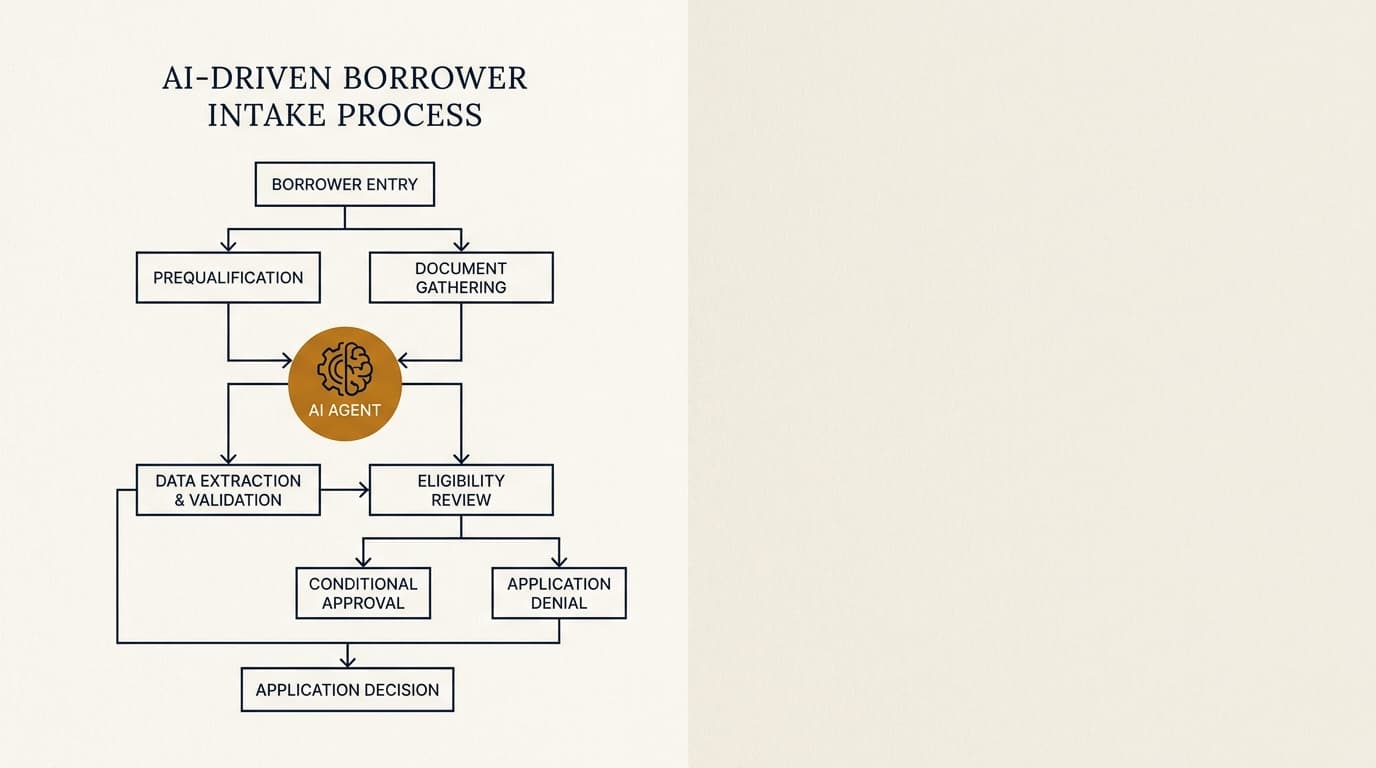
In practice, the workflow starts with data pulled from borrower-submitted operating statements, rent rolls, appraisals, offering memoranda, and loan term sheets. If the lender already uses ai agents for borrower intake or ai agents for cre document analysis, the DSCR/LTV agent can work from normalized fields instead of re-keying everything. That lets the system answer narrow underwriting questions such as:
- Is DSCR based on trailing 12-month NOI, annualized in-place NOI, or underwritten stabilized NOI?
- Is debt service calculated using the note rate, a stressed rate, or a debt constant from policy?
- Is LTV measured against appraised as-is value, as-complete value, purchase price, or a lender haircut to value?
- Do the figures in the credit memo match the source documents and approved assumptions?
The Federal Deposit Insurance Corporation guidance on prudent commercial real estate lending expects underwriting standards tied to reliable repayment sources and collateral evaluation. The Office of the Comptroller of the Currency interagency guidance on concentrations in commercial real estate lending makes the same basic point on policy consistency, stress analysis, and risk identification. An AI agent fits that framework only if its calculations are traceable and reviewable.
Which inputs matter most for DSCR and LTV
Most DSCR and LTV variance comes from input selection, not mathematical error. The same property can produce very different ratios depending on which NOI definition, debt service method, and value basis the lender allows.
The table below shows the inputs that move the numbers most and the discrepancies an agent should catch before an analyst relies on the output.
| Input category | Examples | Common inconsistency | Why it changes the result |
|---|---|---|---|
| Income basis | T-12 NOI, annualized current NOI, stabilized NOI | Credit memo uses stabilized NOI while screening model uses trailing NOI | Directly changes DSCR numerator |
| Debt service basis | Actual payment, underwritten constant, stressed rate | Interest-only period treated as permanent payment | Can overstate DSCR in transitional deals |
| Valuation basis | As-is appraisal, purchase price, broker opinion, as-complete value | LTV cited against purchase price but exception tested against appraisal | Changes collateral leverage and policy flags |
| Reserve treatment | TI/LC, replacement reserves, tax and insurance escrows | Reserves excluded in one model and included in another | Reduces underwritten cash flow |
| Occupancy assumptions | Actual occupancy, physical occupancy, economic occupancy | Rent roll vacancy does not match T-12 vacancy loss | Affects NOI normalization |
| Timing | Appraisal date, trailing period end date, rate lock date | Old appraisal paired with current debt sizing assumptions | Makes LTV and DSCR internally inconsistent |
The Federal Reserve supervisory guidance on real estate lending and appraisal practices is clear that collateral valuation needs to match current underwriting and risk measurement. The National Council of Real Estate Investment Fiduciaries data resources also point to a reality every underwriter already knows: income performance and valuation conditions can move materially by market and property type. That is exactly why valuation dates and market assumptions need to be explicit in the file.
How an AI agent calculates and validates DSCR and LTV
The best agents follow a fixed calculation sequence and lock each assumption before they produce ratios. That makes the output reproducible and, just as important, easy to challenge.
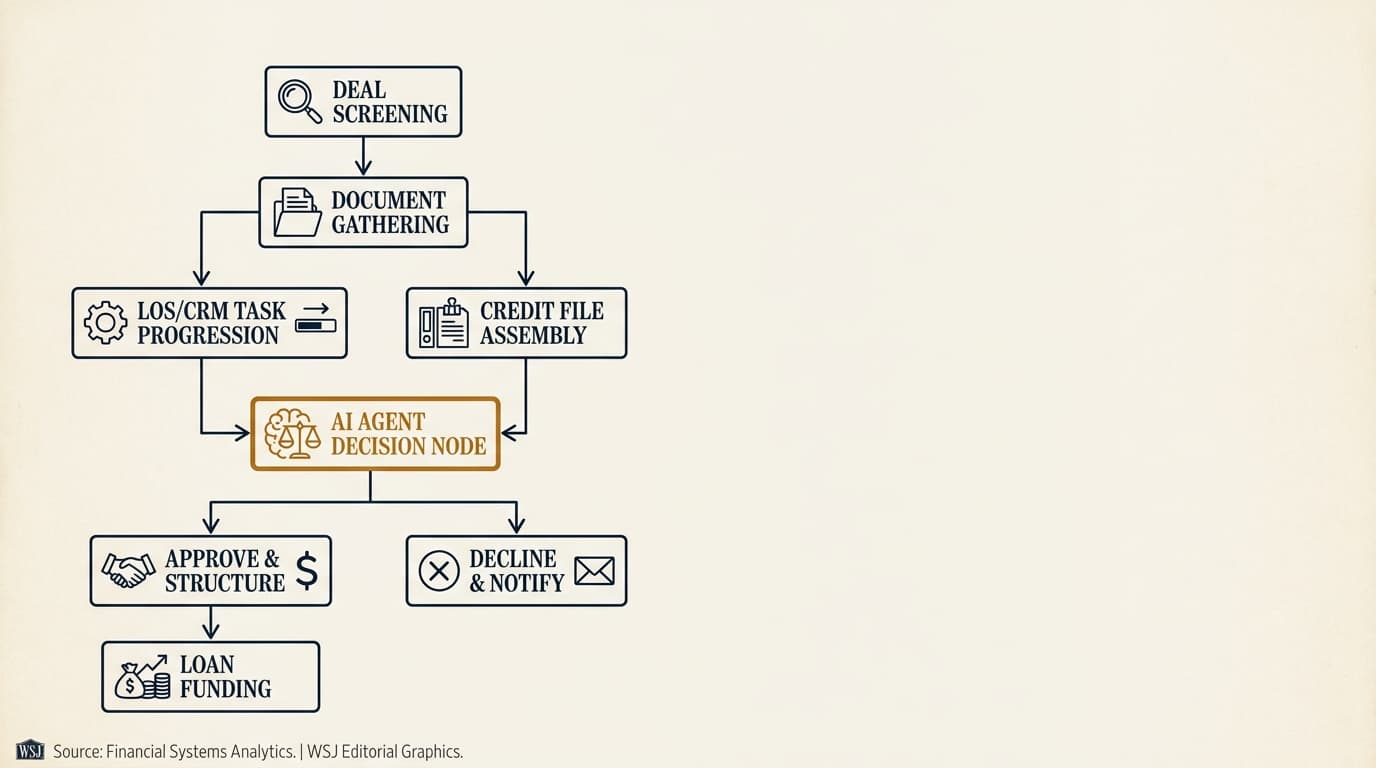
- Collect source documents and map fields from rent rolls, operating statements, appraisals, and loan terms.
- Normalize the data into a standard underwriting schema, including period dates, unit counts, rent figures, expense categories, and debt terms.
- Apply lender policy to define the approved NOI basis, reserve treatment, and debt service method.
- Calculate DSCR using the selected NOI and debt service figures.
- Calculate LTV using the approved loan amount and permitted valuation basis.
- Run variance checks against prior submissions, memo figures, and policy thresholds.
- Escalate assumption conflicts, missing fields, or threshold breaches to an analyst.
- Publish an audit record showing formulas, source locations, and exception notes.
A direct answer for the target query: AI agents for DSCR and LTV analysis are software agents that ingest borrower, property, and market data, calculate debt service coverage ratio and loan-to-value under lender-specific rules, and flag conflicts such as mismatched NOI periods, outdated valuations, or incorrect debt service assumptions. The real value is not speed alone. It is speed with a usable audit trail.
A simple example makes the point. Assume a multifamily loan request with underwritten NOI of $1.25 million and annual debt service of $950,000. DSCR is 1.32x. If the term sheet still carries an interest-only period at $810,000 of annual debt service, DSCR jumps to 1.54x. The math is right in both cases. The assumptions are not. On collateral, a $15 million loan against a $20 million appraised as-is value produces 75% LTV, but the same loan against a sponsor's older $22 million valuation shows up as 68.2% LTV. An agent should not just compute both numbers and move on. It should identify which number fits policy and show why.
That validation layer usually depends on extraction quality upstream. Lenders dealing with document-heavy files often pair this function with ai document extraction for rent rolls and broader ai agents for cre document analysis so lease economics, occupancy, and T-12 line items enter the model in a structured format.
Where inconsistent assumptions usually appear
Most avoidable underwriting errors happen at the handoff between raw documents and credit judgment. This is where an AI agent earns its keep, because it can compare those handoffs line by line.
NOI definition mismatches
DSCR changes the moment NOI shifts from trailing performance to stabilized performance. Transitional assets, recent lease-up stories, and properties with nonrecurring expenses create the most disagreement.
The Appraisal Institute resources on income approach standards make a basic but important point: valuation and underwriting depend on clearly stated income assumptions and normalization methods. In practice, an agent should flag files where a credit memo uses pro forma rents but the debt sizing worksheet still points to in-place occupancy.
Debt service errors
Debt service gets understated when an analyst or broker model carries forward an interest-only period or drops stressed rate assumptions required by policy. Floating-rate bridge loans and construction-to-stabilization loans are the usual trouble spots.
This is where a lender may connect the analysis to a broader cre loan origination workflow ai agent so term-sheet changes automatically update debt sizing tests instead of leaving older assumptions behind.
Value basis conflicts
LTV is only comparable across files when the value basis is consistent. As-is value, as-complete value, purchase price, and lender haircut value are different numbers for different purposes. Treating them as interchangeable is how bad comparisons sneak into credit decisions.
The Appraisal Subcommittee resources on appraisal standards oversight emphasize appraisal practices that are documented and supportable. For private lenders, the practical takeaway is simple: every LTV output should identify the valuation source, effective date, and any lender adjustment.
Decision framework: when automation is reliable and when analysts should override it
Automation works best when the file is stable, the documents are current, and the policy choices are clear. Analysts should step in when the asset or capital structure needs interpretation rather than extraction.
| Scenario | Agent-first approach | Analyst override likely needed |
|---|---|---|
| Stabilized multifamily refinance with current appraisal and clean T-12 | Yes | Usually no, unless policy exception appears |
| Bridge loan with lease-up underway and interest reserve | Partial | Yes, to decide in-place vs stabilized DSCR and reserve treatment |
| Mixed-use property with percentage rent tenants | Partial | Yes, because income normalization may require manual judgment |
| Acquisition with sponsor value-creation narrative but limited operating history | Partial | Yes, especially on valuation basis and pro forma credibility |
| Portfolio loan with cross-collateralized assets | Limited | Yes, to allocate NOI, value, and debt consistently |
This is the part a lot of software pages dodge. The issue is not whether the agent can calculate DSCR or LTV. It can. The underwriting question is whether the assumptions should be treated as settled facts. On a stabilized refinance, automation may strip out most of the manual work. On a transitional hotel or mixed-use redevelopment, the bigger win is often documenting exactly why the file needs human escalation.
Teams that want a closer look at those boundaries should also review ai underwriting for private lenders, which covers what should stay with analysts even when document review and ratio calculation are automated.
Controls, audit trails, and policy alignment
An underwriting ratio only matters if another reviewer can reproduce it from the file. The control standard should look more like a workpaper than a chat response.
At minimum, the system should log:
- source document name and date for each input field;
- the specific formula version used for DSCR and LTV;
- policy thresholds by product type;
- every manual override, including who changed the value and why;
- time-stamped exception flags for missing, stale, or conflicting inputs.
The Consumer Financial Protection Bureau resources on adverse action and credit decision documentation point to the same core requirement: decision records need to support consistent and explainable outcomes. Private CRE files also benefit from links to adjacent control functions such as ai agents for cre lending compliance and post-close reviews through ai agents for portfolio monitoring or ai agents for loan servicing, where covenant tests and updated valuations can be tracked over time.
The real operating advantage is not that the model can reach a ratio in seconds. Spreadsheet math already does that. The advantage is that an agent can preserve one calculation chain from borrower intake through underwriting and into servicing, with fewer silent assumption changes along the way.
Frequently Asked Questions
What is the main benefit of ai agents for dscr and ltv analysis?
The main benefit is consistency. An agent can apply the same lender rules to NOI, debt service, and valuation inputs across every file, then show exactly which source documents support the output. That cuts time spent reconciling spreadsheets and makes exception review more reliable.
Can an AI agent calculate DSCR and LTV without replacing the underwriter?
Yes. In most private CRE workflows, the agent handles data collection, normalization, calculation, and variance checks, while the underwriter decides whether the assumptions fit the asset, market, and loan structure. Transitional assets, floating-rate loans, and pro forma-heavy deals still need analyst judgment.
Which documents should feed a DSCR and LTV agent?
The core inputs are rent rolls, trailing 12-month operating statements, year-to-date financials, appraisals or broker value reports, purchase agreements, organizational borrower information, and loan terms. Market data can help with vacancy, rent, and cap-rate context, but the agent should keep market reference data separate from file-specific underwriting inputs.
How should lenders handle regional market differences in DSCR and LTV analysis?
Regional variation should change assumptions, not calculation logic. Cap rates, vacancy expectations, insurance costs, and tax burdens differ across markets such as Miami, Dallas, and coastal California, and those differences can change NOI normalization and collateral value. The agent should record the market source, date, and any lender haircut applied to local valuation inputs instead of treating all market data as interchangeable.
What controls should exist before using AI-generated ratios in credit decisions?
At minimum, lenders should require source-linked inputs, versioned formulas, policy-based thresholds, analyst approval for overrides, and a complete audit log. Files should also be tested periodically against manual underwriting samples to confirm that extraction and rule application stay accurate as forms, markets, and product policies change in 2026.