AI Agents for KYC and AML in Lending in 2026
Private lenders can use AI agents to gather identity documents, check names against sanctions lists, trace beneficial ownership, and send exceptions to human reviewers. The payoff is faster, more consistent processing, but the control framework still rests on documented policies, vendor oversight, and regulated staff making the final calls.

FinCEN's beneficial ownership reporting rule kicked in for many companies in 2024. At the same time, sanctions programs, Customer Identification Program obligations, and suspicious activity monitoring expectations keep shifting across lenders and counterparties. In that setup, ai agents for kyc and aml in lending can help collect documents, screen entities, and route exceptions faster, but they do not replace regulated controls or final compliance judgment.
This article looks at where AI agents actually fit in private lending operations, especially in commercial real estate and other nonbank credit workflows. It covers identity support, sanctions screening, beneficial ownership mapping, escalation design, and the control boundaries lenders should still keep in place in 2026.
Key Takeaways
- AI agents can cut manual KYC and AML work by collecting documents, standardizing entity data, and routing exceptions, but trained staff should still make the final compliance call.
- According to FinCEN's Customer Due Diligence Rule resources, covered financial institutions must identify and verify beneficial owners of legal entity customers when the rule applies.
- Sanctions screening is only as good as the match logic, alias handling, and escalation rules behind it. False positives are still common in entity-heavy lending files.
- A workable model separates low-risk automation from high-risk judgment: collect, normalize, compare, score, and escalate.
- For broader context on adjacent workflows, see ai agents for private commercial real estate lending and ai agents for cre lending compliance.
What AI agents for KYC and AML in lending actually do
AI agents for KYC and AML in lending are workflow systems. They gather borrower and guarantor information, extract entity data from documents, run screening steps against defined data sources, and escalate exceptions for human review. They work best on repetitive operational tasks, not on unsupervised legal or regulatory decisions.
In practice, a private lender might use an agent to request formation documents, parse a driver's license or passport, pull legal names from an operating agreement, compare names against sanctions and politically exposed person databases, and build a case file showing what was checked and when. That's useful, but it is not a full AML program. According to the Federal Financial Institutions Examination Council BSA/AML Examination Manual, an AML framework still depends on risk-based internal controls, independent testing, designated personnel, and training.
The operational value is pretty simple:
- less rekeying across intake, compliance, and underwriting systems
- fewer missed fields in entity-heavy borrower files
- more consistent screening evidence
- faster routing of ambiguous matches to analysts
That distinction matters for private lenders building connected workflows. KYC and AML support often starts upstream in ai agents for borrower intake, then feeds origination and underwriting rather than sitting off to the side as a separate tool.
Where AI agents fit in a private lending AML workflow
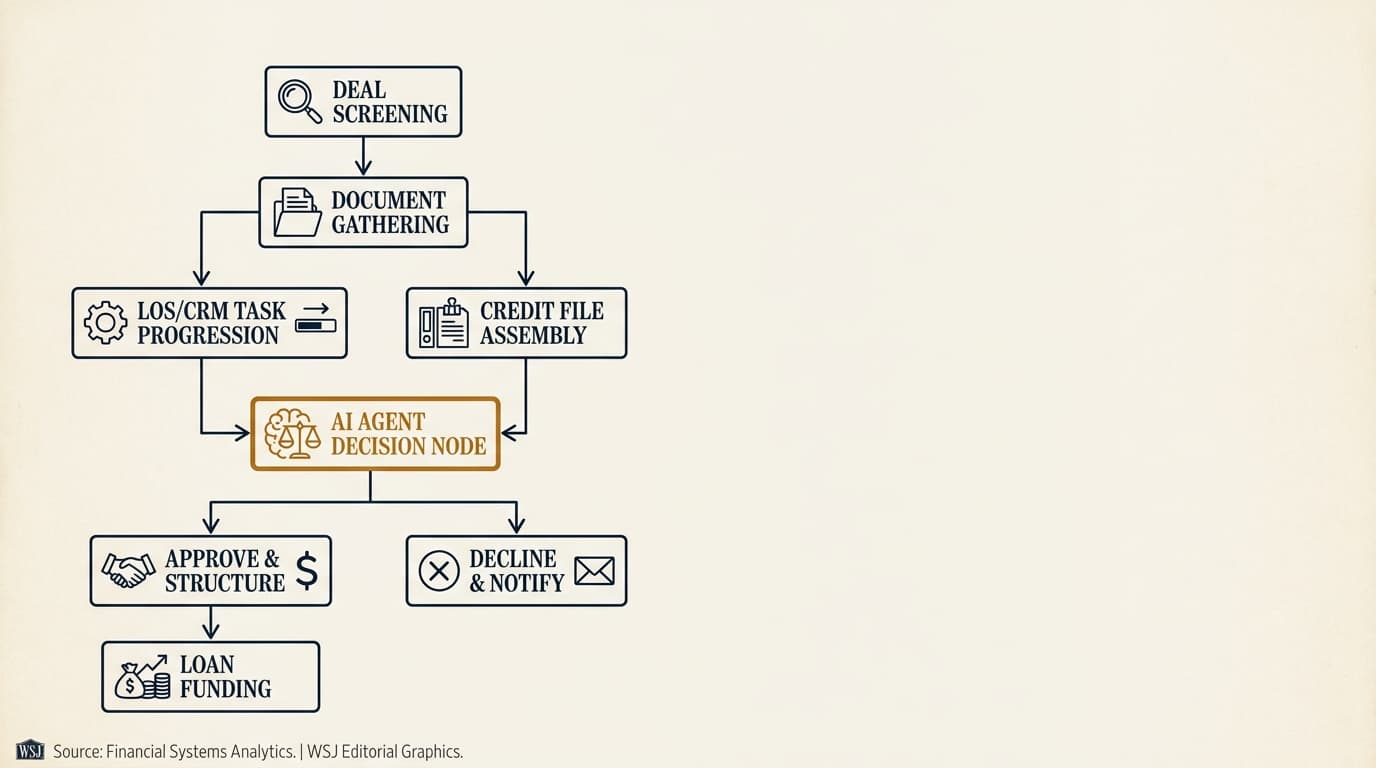
The best use case is orchestration across fragmented tasks. Private lending teams often juggle identity checks, entity documents, sanctions screens, and beneficial ownership review across email, spreadsheets, LOS fields, and third-party screening tools.
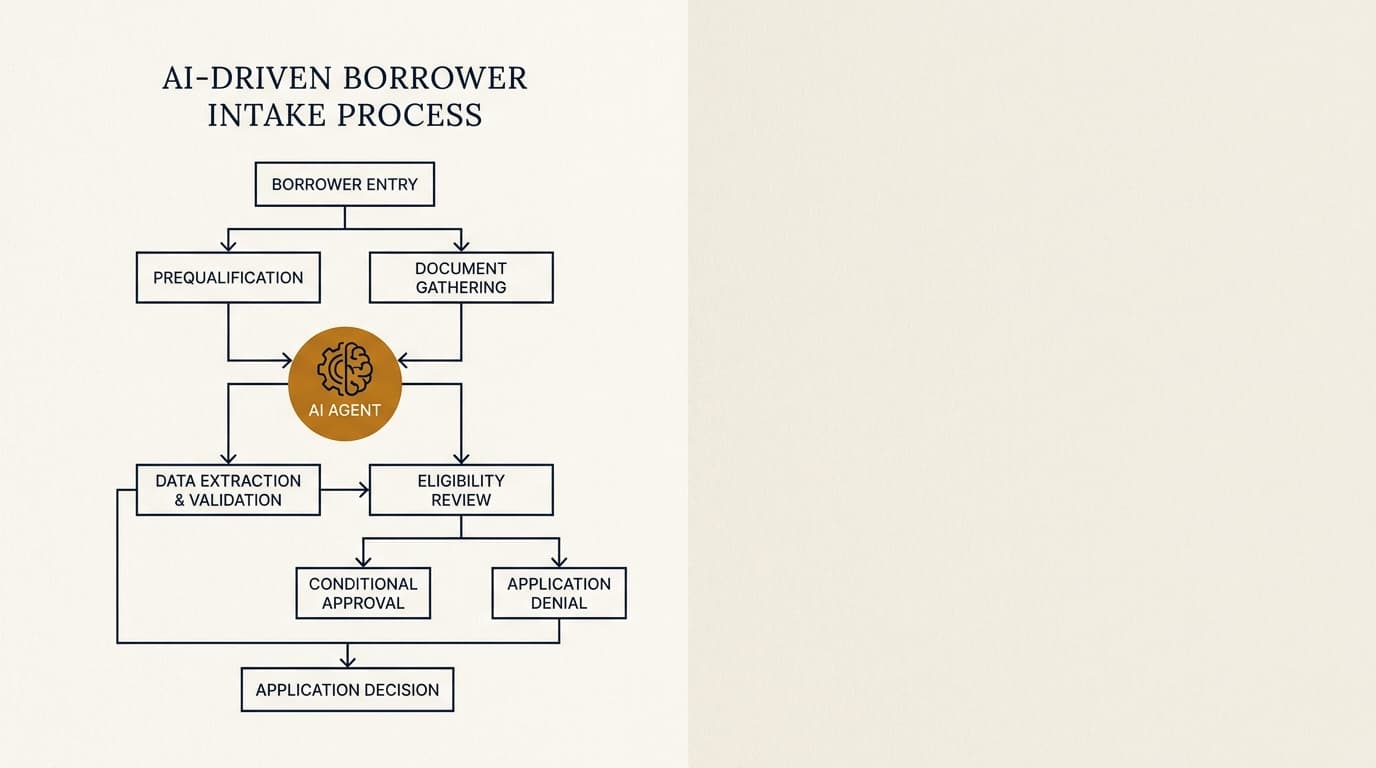
A practical AI-assisted AML workflow usually looks like this:
- Request borrower, guarantor, and control-person information through standardized intake forms.
- Extract names, addresses, dates of birth, tax identifiers, and entity registration details from submitted documents.
- Normalize data formats so the same party appears consistently across the file.
- Run screening against approved sanctions, watchlist, and adverse media sources.
- Map direct and indirect ownership to identify beneficial owners and controlling individuals.
- Score exceptions based on match confidence, missing information, and policy triggers.
- Escalate unresolved issues to compliance or legal personnel for documented review.
- Store the decision trail, evidence, timestamps, and source records for audit purposes.
This sequence overlaps with ai agents for cre loan origination and a broader cre loan origination workflow ai agent design. The difference is that KYC and AML steps need tighter evidence handling, more careful exception review, and a cleaner separation between machine assistance and regulated judgment.
Identity verification and CIP support
Customer identification is document-heavy, rules-based, and repetitive, which makes it a good fit for AI-assisted support. The agent's job is to collect required data, check for completeness, compare fields across documents, and flag inconsistencies before a human reviewer signs off.
According to FinCEN resources on section 326 of the USA PATRIOT Act, Customer Identification Program requirements are meant to help institutions form a reasonable belief that they know the true identity of each customer. For legal entities in private lending, that usually means multiple layers of review: the borrowing entity, key principals, guarantors, and sometimes trust or fund structures.
AI agents can support this process by:
- extracting identity fields from government IDs and business records
- checking whether addresses match formation documents, tax records, and bank statements
- flagging expired documents or incomplete files
- catching likely OCR or transcription errors that would break downstream screening
A common real-world example is a single-asset borrowing entity with two individual guarantors and one management company. A manual team may need to reconcile slightly different spellings across the certificate of formation, operating agreement, driver's licenses, and wire instructions. The agent can surface those discrepancies right away, while compliance decides whether they are clerical issues or signs of something bigger.
Sanctions screening and watchlist review
Sanctions screening is a matching problem first and a policy problem second. The technology needs to handle aliases, transliterations, entity suffixes, and incomplete data, but the lender still needs written rules for what counts as a true match, a false positive, and a required escalation.
According to the U.S. Department of the Treasury Office of Foreign Assets Control sanctions program resources, sanctions obligations vary by program and list. According to OFAC compliance guidance and FAQs, a risk-based sanctions compliance program should include internal controls, testing, and training. An AI agent can support those controls by automating first-pass comparisons, but it should not be the final authority on blocked-party determinations.
| Screening task | AI agent support | Human control point |
|---|---|---|
| Name matching | Normalize aliases, compare spelling variants, rank likely matches | Review medium- and high-confidence hits |
| Entity screening | Parse LLC, LP, Inc., and trade-name variants | Confirm legal entity identity and ownership linkages |
| Adverse media triage | Group articles by subject and issue type | Decide relevance, recency, and materiality |
| Ongoing rescreening | Trigger repeat checks at renewal, modification, or funding | Approve action on newly surfaced matches |
The main operational problem is false positives. A lender screening real estate sponsors will run into repeated names, family offices, and layered LLC structures all the time. A useful agent cuts down irrelevant hits by preserving context — date of birth, jurisdiction, registration number, address, and ownership path — instead of matching on name alone.
Beneficial ownership checks in private lending
Beneficial ownership review is where many private lending files get labor-intensive. The hard part is not collecting one name. It is tracing who owns or controls the borrowing entity when the structure includes holding companies, trusts, or investment vehicles.
According to FinCEN beneficial ownership information reporting resources, reporting under the Corporate Transparency Act created a separate federal reporting regime, but lenders still need to meet their own customer due diligence obligations where applicable. Those are related issues, but they are not the same. If a vendor claims that access to beneficial ownership information eliminates lender-side review, that's an oversimplification.
AI agents can help by reading operating agreements, organizational charts, subscription materials, and secretary of state records, then building an ownership graph for review. This is one place where integration with ai agents for cre document analysis is especially useful, because beneficial ownership facts often sit inside unstructured PDFs rather than clean system fields.
Beneficial ownership edge cases
Edge cases are common in private lending, especially in CRE deals. Family trusts, bankruptcy-remote single-purpose entities, foreign holding companies, and manager-managed LLCs can all change who needs review and what evidence is enough.
- A manager-managed LLC may show control resting with a person who owns less than the threshold percentage.
- A trust structure may require review of trustees, settlors, or beneficiaries depending on the lender's policy and the account relationship.
- A fund borrower may have dispersed economic ownership but a small number of control persons with decision authority.
This is where AI agents help through organization, not conclusion. They can map the structure, identify missing links, and present the case for a compliance decision. They should not infer legal ownership status without documented policy rules and reviewer oversight.
A practical escalation model for exceptions and false positives
The best design separates clerical exceptions from compliance exceptions. That cuts analyst time spent on incomplete packets while making sure possible sanctions or ownership issues move quickly to the right reviewers.
A workable model uses three lanes:
- Lane 1 — auto-clear administrative issues: missing zip code, unreadable image, expired document, incomplete signature block.
- Lane 2 — analyst review: inconsistent entity names, partial ownership gaps, weak identity match, adverse media with unclear relevance.
- Lane 3 — compliance or legal escalation: sanctions hit, known high-risk jurisdiction, unexplained nominee structure, refusal to provide ownership information.
The practical issue is that most delay comes from mixed queues, not from sanctions review itself. If intake defects, OCR failures, watchlist noise, and actual AML concerns all land in one inbox, high-risk items sit behind low-risk cleanup work. An AI agent can separate those queues and preserve service levels without changing the lender's approval authority.
That queue design also improves handoffs to ai agents for cre underwriting and ai underwriting for private lenders. Underwriting should get a clear status such as cleared, pending compliance review, or conditional pending ownership clarification, not a pile of unresolved screening notes.
What AI agents should not decide on their own
There are clear boundaries on what an AI agent should do in AML-sensitive workflows. It should not independently approve a high-risk customer, dismiss a sanctions alert without review where policy requires escalation, or make legal conclusions about beneficial ownership in ambiguous structures.
According to the Office of the Comptroller of the Currency's model risk management guidance and the Federal Reserve's SR 11-7 model risk management framework, institutions using models need governance, validation, and controls that match the use case. Even if a lender is not supervised exactly like a large bank, the principle still holds: higher-risk automated decisions need stronger validation and oversight.
Private lenders should keep humans in the loop for:
- true-match sanctions determinations
- suspicious activity escalation decisions
- enhanced due diligence on high-risk borrowers or jurisdictions
- exceptions to documented CIP, KYC, or beneficial ownership policy
How private lenders should evaluate vendors and controls
Vendor evaluation should focus on evidence quality, explainability, and operational fit. A polished demo matters a lot less than whether the system can show source records, confidence scores, and an audit trail tied to each screening and escalation event.
Use this checklist during evaluation:
- Confirm which data sources the platform uses for sanctions, watchlists, and entity verification.
- Review how often those sources refresh and whether updates are timestamped in the case file.
- Test false-positive handling on real borrower and guarantor names with common spelling variants.
- Check whether beneficial ownership mapping can handle multi-tier entities, trusts, and manager-managed LLCs.
- Verify that every exception, override, and reviewer action is logged for audit purposes.
- Require role-based permissions so screening results and sensitive identity data are not broadly exposed.
- Document where the agent hands off to human compliance, legal, or credit staff.
For private lenders building a connected stack, this work should be coordinated with adjacent systems such as ai agents for loan servicing for post-close rescreening events and ai agents for portfolio monitoring where borrower status changes may justify a refreshed review.
Frequently Asked Questions
Can AI agents perform KYC and AML checks without human review?
No. AI agents can automate collection, extraction, screening, and prioritization, but lenders should keep human review for policy exceptions, likely sanctions matches, beneficial ownership ambiguity, and suspicious activity decisions. The right boundary depends on the lender's risk profile, jurisdiction, and documented compliance program.
What is the difference between beneficial ownership screening and sanctions screening?
Beneficial ownership screening identifies who owns or controls the customer, while sanctions screening compares relevant persons and entities against sanctions lists and related risk sources. In practice, lenders need both. An entity can look low-risk on its face but still connect to a sanctioned or high-risk person through ownership or control.
Do private CRE lenders need a different workflow than consumer lenders?
Yes. Private CRE lenders usually deal with LLCs, SPEs, guarantor structures, trusts, and layered ownership, which makes beneficial ownership work more document-heavy than in many consumer workflows. That's why entity parsing, organizational-chart review, and exception routing matter more in commercial files.
How should lenders handle false positives in sanctions screening?
They should use documented review rules that consider full legal name, aliases, address, date of birth, jurisdiction, entity registration details, and ownership context. A good process clears obvious administrative mismatches quickly, routes ambiguous results to analysts, and escalates credible matches to compliance or legal staff with a complete audit trail.
Does location matter for KYC and AML workflows in lending?
Yes. U.S. federal requirements are only part of the picture. State licensing rules, investor requirements, warehouse line covenants, and foreign ownership exposure can all affect what information a lender collects and how reviews are escalated. Cross-border borrowers, foreign beneficial owners, or property-owning entities in multiple states usually require closer review than a domestic single-member LLC with a straightforward structure.